Popular Items in Camping (Outdoor) Knives

 ポイント10%
 ポイント15%
 ポイント10%ポイント15%
Camping (Outdoor) Knives
ポイント10%ポイント15% ポイント10%ポイント15%
 ポイント10%ポイント15%
 ポイント10%ポイント15%
What Makes Camping Knives So Appealing? Tips on How to Choose and Carry Them

Camping knives are highly portable and can be taken outdoors. They are useful not only for camping but also for various outdoor activities such as hiking, fishing, and motorcycle camping.
Since each camping knife differs in blade design and storage method, many people may find it difficult to decide which one to choose.
In this article, we’ll explain in detail the appeal of camping knives, how to choose one, and precautions for carrying them. We’ll also introduce recommended items to use alongside your camping knife.
If you want to enjoy the outdoors with ease and style, please use this as a guide.
What Is a Camping Knife?

A camping knife is a knife designed to safely store the blade—which poses a risk of injury—so it can be carried securely.
Its main uses include:
- Cooking
- Battling (splitting firewood)
- Bushcraft
, among others.
Battoning is a method of splitting firewood by placing a knife against a log and striking the knife with another log or a hammer. It allows you to split firewood using just a single camping knife, without the need for large tools like axes or hatchets.
Bushcraft is the art of living using natural items found in the wild, such as fallen branches and leaves. Among bushcraft techniques that utilize a camping knife are making "feather sticks" for kindling, "chopsticks," and "pegs."
A camping knife is an item you can carry safely and use for a variety of purposes, such as cooking and tending the campfire.
Points to Consider When Choosing a Camping Knife

To choose a camping knife, you need to clearly decide what you’ll use it for.
Once you’ve decided on your purpose,
- Type of knife
- blade material
- blade shape
- grip material
.
I’ll explain each point in detail.
Point 1: There are three main types of knives!
The types of camping knives are:
- sheath knives
- Folding Knives
- multi-tool knives
.
-The "sheath knife": a versatile choice recommended for beginners
The versatile "sheath knife" is recommended for beginners as their first knife. A sheath knife is a knife where the blade is stored in the included sheath.
While the blade cannot be folded, this makes it highly durable and suitable for batoning. If you plan to use it for batoning, choose a knife with a blade length of 10–15 cm and a blade thickness of 3.5 mm or more.
You should also pay attention to the "tang" construction. The tang is the part of the blade that is hidden within the handle.
In particular, knives with a "full tang"—where the blade extends through the entire handle—are sturdy and well-suited for batoning.
-If cooking is your main focus, a foldable "folding knife" is recommended
If your primary use involves delicate tasks like cooking, a foldable "folding knife" will be easier to use.
Folding knives allow you to fold the blade and store it within the handle, making them compact and safe to carry.
Additionally, since the blade is thinner than that of a sheath knife, it is well-suited for detailed tasks like cutting vegetables and meat. However, due to its construction, it is less durable and not suitable for tasks that require significant force, such as batoning.
-The “multi-tool knife” you’ll want to keep as a backup
Also known as a Swiss Army knife or utility knife, the “multi-tool knife” is a multifunctional knife that includes convenient tools such as a bottle opener, can opener, scissors, and saw in addition to the blade.
Carrying a multi-tool knife as a backup knife will prove useful in a variety of outdoor situations.
Point 2: You should also know the blade material
Camping knives typically feature blades made of either "stainless steel" or "carbon steel." Since the usability differs depending on the material, choose the one that suits your preferences.
-"Stainless Steel": Rust-Resistant and Highly Durable
While stainless steel blades are slightly less sharp than carbon steel ones, their appeal lies in their high durability and resistance to chipping.
They also feature excellent corrosion resistance and are highly resistant to rust. After use, simply rinse with water and let it dry—no special maintenance is required.
Stainless steel is recommended for beginners because it is easy to handle.
-Exceptional sharpness! “Carbon steel” is recommended for cooking
Carbon steel blades are harder than stainless steel and offer exceptional sharpness. However, because they are so hard, they are also more prone to chipping.
While sharpening with a whetstone can restore their sharpness, they are prone to rust, so they require proper care after use, such as drying them thoroughly and applying oil.
Carbon steel knives are best suited for experienced campers who have the time and patience to care for their tools properly.
Point 3: We recommend a "Scandi grind" for the blade
In the context of camping knives, "grind" refers to the way the blade is shaped, which is determined by examining the cross-sectional profile of the blade.
The grind is
- Hollow
- Full Flat
- Flat
- Scandi
- Convex
- Chisel
These are classified into six types.
The "Hollow," "Full Flat," and "Flat" types have thin, sharp edges, making them suitable for detailed tasks like cooking. However, because the edges are thin, they lack durability and are not suitable for batoning.
The "Scandi," "Convex," and "Chisel" types have thick blades and high strength, making them suitable for batoning. Among these, the "Scandi" is easy to resharpen and is the recommended grind for beginners.
Point 4: Choose a resin grip that is slip-resistant and easy to hold
If the grip of a camping knife is slippery, the risk of injury increases. Beginners who are not yet accustomed to handling knives should prioritize safety and choose a knife with a non-slip, easy-to-hold grip.
Camping knife grips are primarily made of either "wood" or "resin."
Wooden grips are attractive for their beautiful appearance and warm, natural feel. On the other hand, they can be slippery, so caution is required when using them.
Resin grips offer a comfortable, secure fit and are less slippery, making them ideal for beginners.
Next, consider the shape of the grip. Products with notches for your fingers or curves designed to fit the shape of your hand are recommended because they are easy to grip.
Precautions When Carrying a Camping Knife

If you’re not careful when carrying a camping knife, you may violate the law. To ensure you don’t break any laws, be sure to carefully review the following precautions.
Point 1: Potential Violations of the Firearms and Swords Control Law and the Minor Offenses Act
Under Japanese law, carrying bladed weapons without a legitimate reason is prohibited. Knives with a blade length of 6 cm or more violate the "Firearms and Swords Control Law," while those under 6 cm violate the "Minor Offenses Act."
Of course, camping qualifies as a legitimate reason, so there is no problem with bringing a knife. However, if you carry a knife around on a daily basis simply because “it might come in handy,” you will be breaking the law.
Furthermore, you must be careful about how you carry it. It is prohibited to carry a knife in a way that allows it to be drawn immediately. Be sure to store it in a case and transport it to the campsite along with your other cooking utensils.
Point 2: Do not leave it in the car
Many people probably leave their camping gear in the car even after returning from a trip.
If your camping knife is among the gear left in the car, you risk violating the law. In particular, if you leave it in the glove compartment on the dashboard, it will be considered to be in a state where it can be drawn immediately.
There have been many cases where people were arrested after knives were found during police stops or checkpoints, so caution is necessary. When you return home from camping, even if it’s a hassle, do not leave them in the car; be sure to store them at home.
[TOKYO CRAFTS Outdoor Knives] Items that are convenient to use with the Delta Talon
TOKYO CRAFTS’ camping knife, the “Delta Talon,” is an all-purpose sheath knife. With a blade length of approximately 12.5 cm, a blade thickness of 3.5 cm, a full-tang construction, and a high-strength, easy-to-sharpen Scandi grind, it handles batoning with ease.
Additionally, various design features have been incorporated into the grip and blade to make cooking easier.
The blade is made of durable, low-maintenance stainless steel, while the grip uses non-slip “G10” resin. It’s a camping knife that’s easy to use, even for beginners.
Next, we’ll introduce some items that pair well with TOKYO CRAFTS’ outdoor knife, the “Delta Taron.”
Jikama Nita
The "Jikamanita" is a cutting board with legs that can be used in two ways: as a standard cutting board when the legs are removed. The cutting board surface is made of acacia wood with a beautiful grain. We recommend using it not only as a cutting board but also as a mini table or serving tray.
The legs, which fold up and store inside the cutting board, feature a modular design that’s compatible with the “Jikata Table.” Since the cutting board section can be swapped out for the Jikata Table’s tabletop, it helps you achieve a minimalist camping setup with less gear.
Zika Table
The "Zika Table," which shares legs with the Zika Manita, is the perfect camping table for solo camping.
Mini tables with a narrow width can be difficult to use. The Zika Table has a generous width of 39 cm. Plus, when folded, it fits perfectly into a backpack.
The tabletop is made of stainless steel, allowing you to place burners and hot pots directly on it.
By incorporating a perforated finish on the tabletop and using resin for the legs, we’ve succeeded in keeping the weight under 500g. It’s recommended not only for car camping but also for backpacking, touring, and hiking.
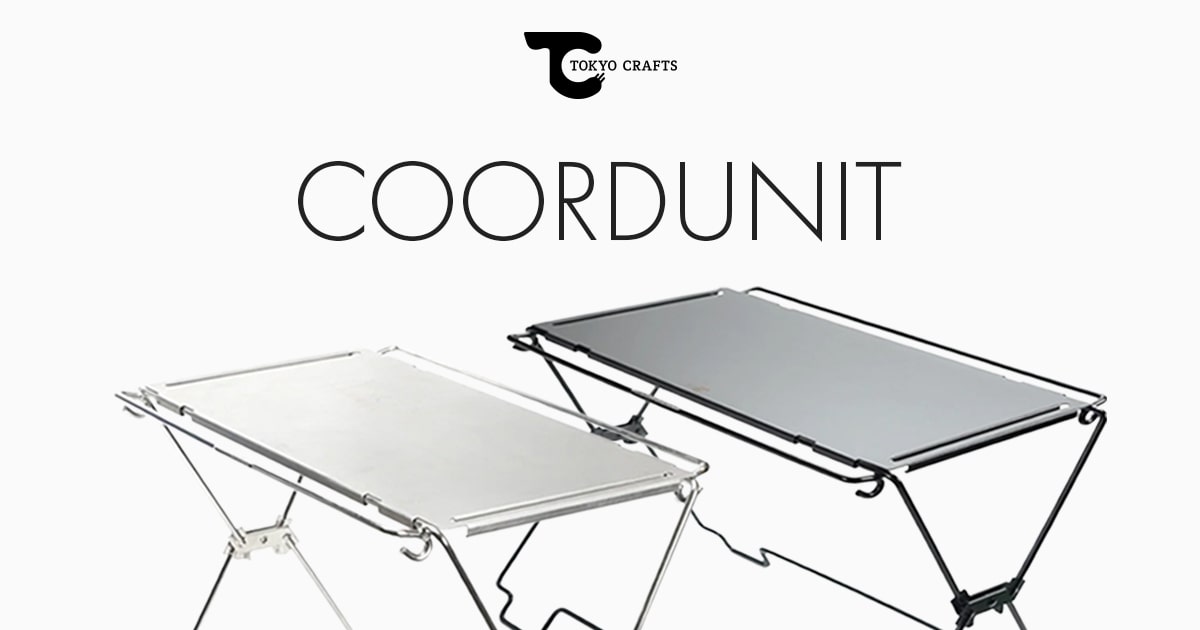
Cord Unit
On its own, the Cord Unit can be used as a mini table or storage shelf. By connecting them vertically or horizontally, or stacking them in two tiers, the range of uses expands significantly.
Surround a fire pit with multiple Cord Units to create a traditional hearth-style table.
It can also be combined with other compatible items (Multi-Bag, Bucket Shelf Mesh), offering endless possibilities for use.
Float Case
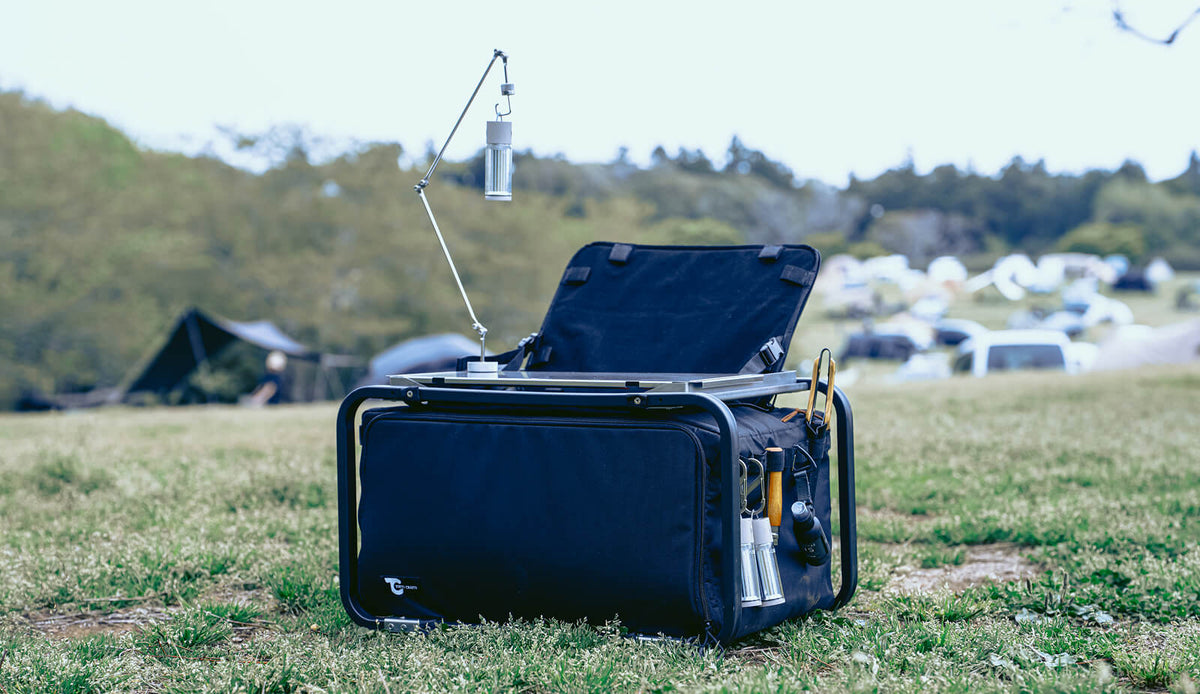
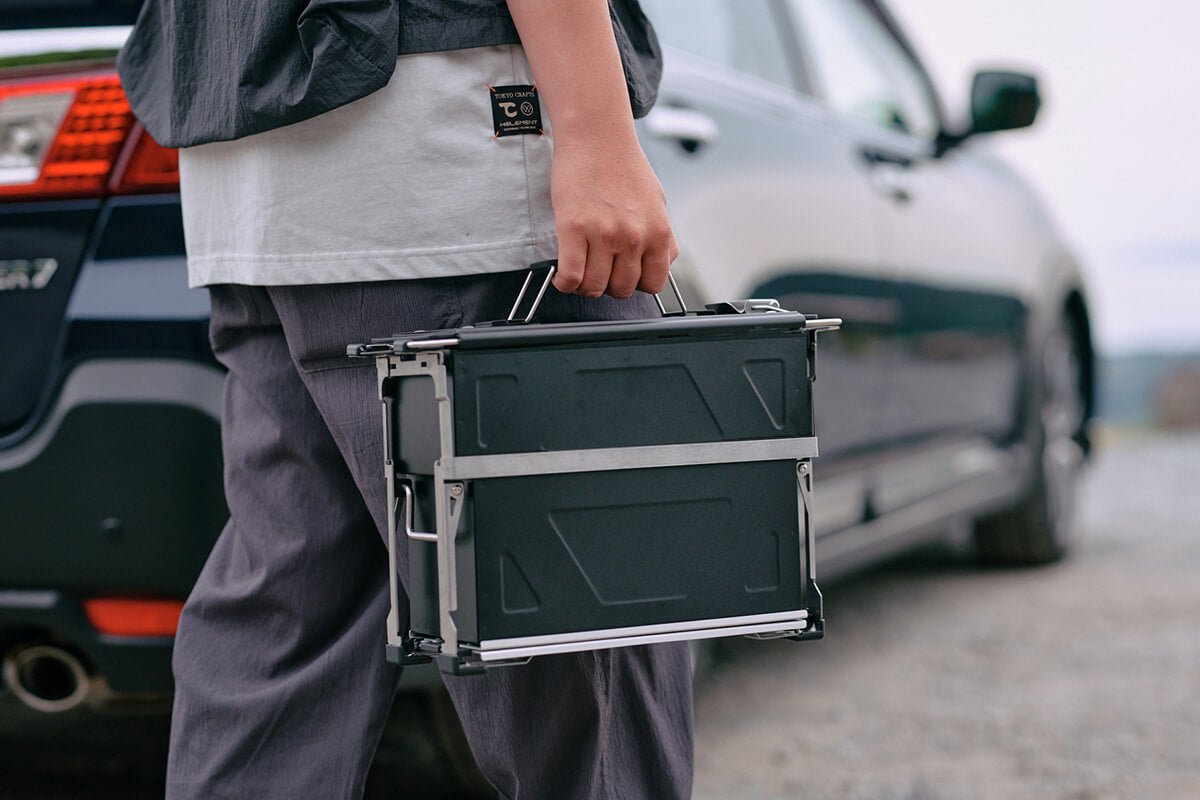
The "Float Case" is an organizer designed to store all your small camping gear. Its compact size makes it easy to carry, and thanks to its built-in frame, you can place it directly on the ground wherever you like.
It’s ideal for holding cooking utensils like seasonings and camping knives, so you can take it to the cooking area or around the campfire.
Bucket Shelf Mesh
The "Bucket Shelf Mesh" is also recommended for storing cooking utensils. The storage compartment uses breathable mesh fabric and can be washed with water if it gets dirty. Compared to hard materials, the fabric has some give, making it highly versatile for storage.
You can also stack two of these units on top of each other. Furthermore, it’s compatible with the Cord Unit, allowing for various combinations.
It’s handy to have a camping knife! Find the one that suits your needs and style!
Camping knives are versatile tools suitable for cooking, chopping firewood, bushcraft, and more. The appeal lies in being able to camp light and free without having to carry tools like kitchen knives or axes.
The best camping knife for you depends on how you plan to use it. Be sure to choose the one that best suits your needs so you can enjoy a smart camping experience.
RANKING
ランキング一覧へ ポイント10%ポイント15%
 ポイント10%ポイント15%
 ポイント10%ポイント15%
 ポイント10%ポイント15%
 ポイント10%ポイント15%
 ポイント10%ポイント15%
 ポイント10%ポイント15%
 ポイント10%ポイント15%
 ポイント10%ポイント15%


 ポイント10%ポイント15%
 ポイント10%ポイント15%
 ポイント10%ポイント15%
 ポイント10%ポイント15%
 ポイント10%ポイント15%
 ポイント10%ポイント15%
ポイント10%ポイント15%
ポイント10%ポイント15%
ポイント10%ポイント15%
ポイント10%ポイント15%
ポイント10%ポイント15%
ポイント10%ポイント15% ポイント10%ポイント15%
 ポイント10%ポイント15%
 ポイント10%ポイント15%
ポイント10%ポイント15%
ポイント10%ポイント15%
ポイント10%ポイント15%
ポイント10%ポイント15% ポイント10%ポイント15%
 ポイント10%ポイント15%
ポイント10%ポイント15%
ポイント10%ポイント15%
ポイント10%ポイント15%
ポイント10%ポイント15%
 ポイント10%ポイント15%
 ポイント10%ポイント15%
ポイント10%ポイント15%
ポイント10%ポイント15% ポイント10%ポイント15%
 ポイント10%ポイント15%
 ポイント10%ポイント15%
ポイント10%ポイント15%
ポイント10%ポイント15% ポイント10%ポイント15%
 ポイント10%ポイント15%
 ポイント10%ポイント15%
 ポイント10%ポイント15%
 ポイント10%ポイント15%
ポイント10%ポイント15%
ポイント10%ポイント15%
SEE MORE (その他オススメ商品)
ポイント10%ポイント15% ポイント10%ポイント15%
 ポイント10%ポイント15%