[For Beginners] Learn the Benefits of Large Tents and How to Choose One!
For camping with families or large groups, we recommend a "large tent" where everyone can relax comfortably.
While the term “large tent” covers a wide range of products with different styles and materials, many people may find it difficult to decide which one to choose.
In this article, we’ll provide a detailed overview of the benefits of large tents, how to choose one, and important considerations for purchase and use.
If you want to enjoy a lively camping trip in a large tent packed with features, please use this as a guide.
Benefits of Buying a Large Tent

The biggest appeal of a large tent is, without a doubt, its spaciousness. Since you can relax comfortably in a single tent, there’s no need to set up multiple tents. Additionally, if you choose a “two-room tent” that provides both a bedroom and a living area within the tent itself, you can save yourself the trouble of setting up a tarp.
Since you can stay in a single space, it’s also easier to keep an eye on children, which is a major advantage, especially for family camping.
You can set up camping gear like tables, chairs, and coolers inside the tent, so you can relax without worry even in strong sunlight or sudden rain.
Large tents offer not only width but also height, providing a sense of openness. You can move around and change clothes without having to bend over, so you won’t feel cramped.
However, if you mainly camp with a small group or alone, a one-person tent—which is easier to set up and carry than a large tent—may actually feel more comfortable in some cases.
What are the deciding factors when choosing a large tent?

When choosing a large tent,
- Tent Type
- Number of users
- Material
- Functionality
By keeping these four points in mind, you can choose a product that’s easy to use.
How to Choose #1: First, Learn About the Different Types of Tents
Tents are categorized into several types based on their shape.
For large tents, we recommend the
- dome tents
- single-pole tents
- 2-room tents
. We’ll explain the features and benefits of each in detail.
"Dome Tents" Are Recommended for Camping Beginners

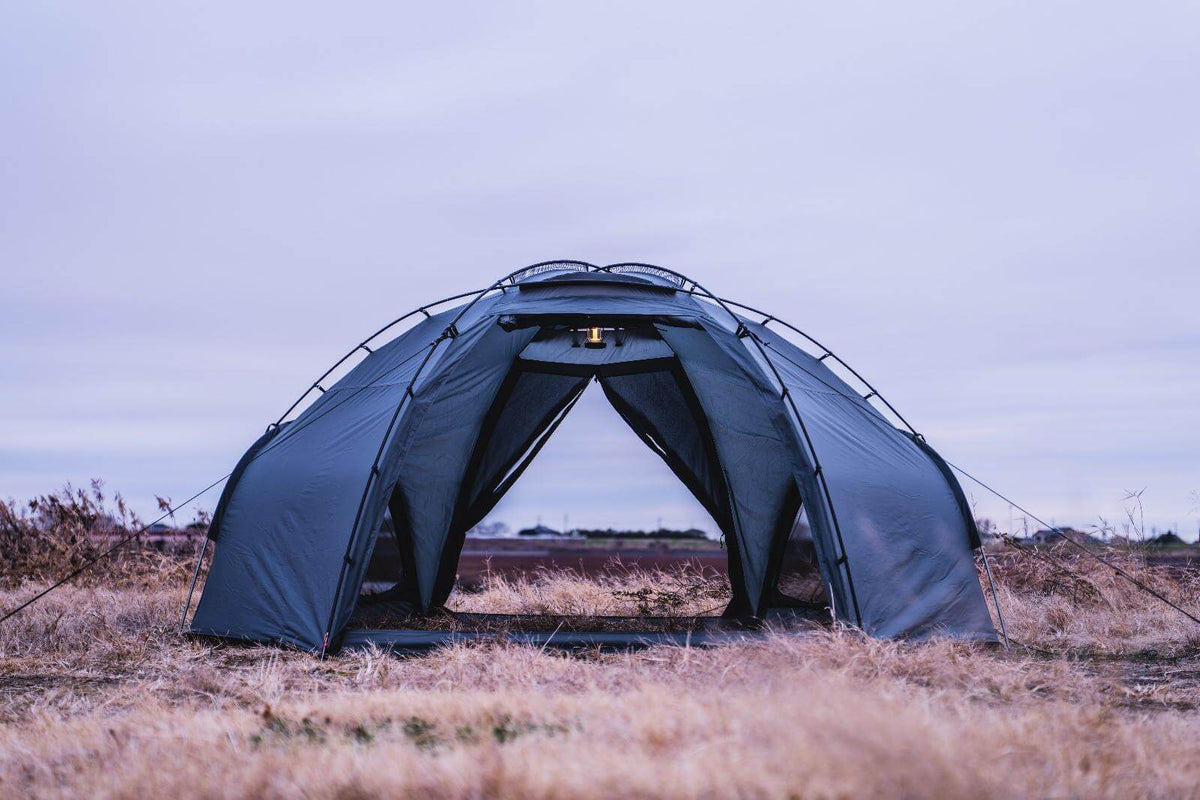
"Dome tents" are single-room tents shaped like a hemisphere. They are easy to set up and take down, making them ideal for beginners. Conventional dome tents are set up by inserting two poles into the tent body in a cross pattern. Their hemispherical shape creates a spacious interior, and their high livability is another reason for their popularity.
Even with the traditional design, larger sizes can accommodate 5 to 6 people. However, since they don’t provide a living area, you’ll need to set up a separate tarp.
Recently, “large dome tents” with a diameter of 4 meters or more have been gaining popularity. While setup is slightly more complex due to the increased number of poles, they are characterized by their spacious interior. For a family of 4–5 people, they provide ample space for both a bedroom and a living area, eliminating the need for a tarp.
The stylish "single-pole tent"

The "single-pole tent" features a stylish pointed roof. Its cute appearance makes it ideal for female campers and family camping trips with small children. While it may look difficult to set up, it’s surprisingly simple—just stake down the tent’s perimeter and erect the pole inside to complete the setup.
This large-sized tent features a high ceiling that creates a sense of openness. It’s spacious enough to sleep 10 people, so for family camping, you’ll likely be able to secure both sleeping and living areas.
Single-pole tents are classified into two types: the conical “teepee-style” and the “bell-style” with upright walls. Because the walls rise higher in the “bell-style,” you can make effective use of space all the way to the edges, making it more suitable for camping with large groups.
"Two-room tents" are convenient for families and groups

"Two-room tents" are divided into two separate spaces: a bedroom and a living area. You can enjoy camping comfortably even without a tarp. On family camping trips, you can relax in the living area even after the kids have gone to sleep.
In a two-room tent, a hanging “inner tent” is attached to part of the main tent structure to create a sleeping area. Since the inner tent is removable, you can enjoy an even more spacious area by taking it down.
Tip #2: For comfort, choose a tent size that accommodates the number of users plus one
Each tent model specifies a "recommended capacity," so use this as your guide when selecting a size.
The "number of users" is set to the "minimum number of people who can just barely fit." Therefore, if you want a tent where everyone can sleep comfortably with plenty of room, we recommend choosing a tent for "the actual number of users plus one."
Tip 3: The appropriate material varies depending on your camping situation
Tents vary significantly in usability and price range depending on the material. Consider your camping style and budget to choose the most suitable material.
– Polyester

"Polyester" is attractive for its light weight and quick-drying properties. Its affordability is another major advantage, making it the most commonly used material for tents.
However, because it has low flame resistance, it is prone to developing holes from sparks, so you must keep a sufficient distance from the campfire when using one. Another drawback is that, compared to other materials, it has poor breathability, making it prone to condensation.
– Cotton

Tents made of cotton have a stylish, natural texture. They offer excellent breathability and are resistant to condensation, making them cool in summer and warm in winter. Another advantage is their high flame resistance, which makes them less likely to develop holes from sparks during campfires.
However, a drawback is that they are heavy and difficult to carry. Furthermore, they take a long time to dry and require time-consuming maintenance after returning home, so they are best suited for those who don’t mind the upkeep.
– TC Fabric

"TC fabric" is a blend of polyester and cotton. It combines the best of both materials and is also known as "poly-cotton."
Compared to cotton, it is lightweight, easy to carry, and dries quickly, reducing the time needed for maintenance. Compared to polyester, it is highly flame-resistant and less prone to developing holes from sparks, which is another advantage. It also retains the pleasant texture of cotton, making it ideal for creating a natural-looking campsite.
It is priced higher than polyester but more reasonably than cotton.
– Nylon

"Nylon" is lightweight, highly durable, and resistant to tearing. It is used in ultralight-style tents designed to keep luggage as light as possible, as well as in mountaineering tents. Although it absorbs moisture easily, it dries quickly, making it an easy-to-maintain material.
Like polyester, it has low flame resistance, so caution is required around campfires and sparks.
Selection Tip 4: Check Water Resistance (Water Column Rating) and Breathability
"Water resistance" is a numerical value that indicates a fabric’s ability to prevent water from seeping in. The higher the number, the less likely water is to penetrate the tent. A water resistance rating of 1,500–2,000 mm is sufficient to withstand prolonged heavy rain.
However, if the water resistance is too high, the fabric’s breathability decreases, making the tent feel stuffy and hot in the summer. Consider the season you’ll be camping in and choose a product with the appropriate water resistance.
If you plan to camp in the summer, the structural ventilation of the tent—not just the fabric—is also important. Tents with multiple entrances, windows, and ventilation openings, as well as those that make extensive use of mesh fabric, provide good airflow and remain comfortable even during hot weather.
If you also want to enjoy winter camping, we recommend tents with a skirt to prevent cold air from entering and a chimney vent that allows you to use a wood-burning stove.
Points to Consider When Purchasing a Large Tent
Because large tents are bigger in size, they are
- Transportation
- storage space
- Packing up
and other factors.
Point 1: Difficult to transport except for car camping
Because large tents have a large packed size and are heavy, transportation is limited to cars.
Even when traveling by car, at campsites where vehicles are not allowed on the tent sites, you’ll have to carry the heavy tent from the parking lot. You’ll need to rent a trailer provided by the campsite or bring your own outdoor wagon.
Point 2: You need to secure storage space
Because large tents have a large packed size, they take up a significant amount of storage space at home. If you live in an apartment or other residence with limited storage space, you may not be able to store it, so please be careful.
Similarly, if your car’s trunk space is limited, you may not be able to fit it inside, so be sure to check the packed dimensions before purchasing.
Point 3: You must pack it up carefully when breaking camp
Large tents consist of many large individual parts. If you don’t fold them carefully when packing up, they won’t become compact, and you may end up with a situation where not all parts fit into the storage case. Since there are also many pegs and poles, be careful not to leave them behind at the campsite.
You must let the tent dry completely before storing it. If it isn’t thoroughly dried, the coating may undergo hydrolysis, causing it to become sticky, or significantly reducing its water resistance and other functionalities.
If you don’t have space to dry the tent on your balcony or in your yard, you’ll have to go out of your way to dry it in a park or open field. Be sure to consider where you’ll be able to maintain it when making your purchase.
TOKYO CRAFTS Large Tents

TOKYO CRAFTS also offers a lineup of large tents perfect for family and group camping.
Wing Fort

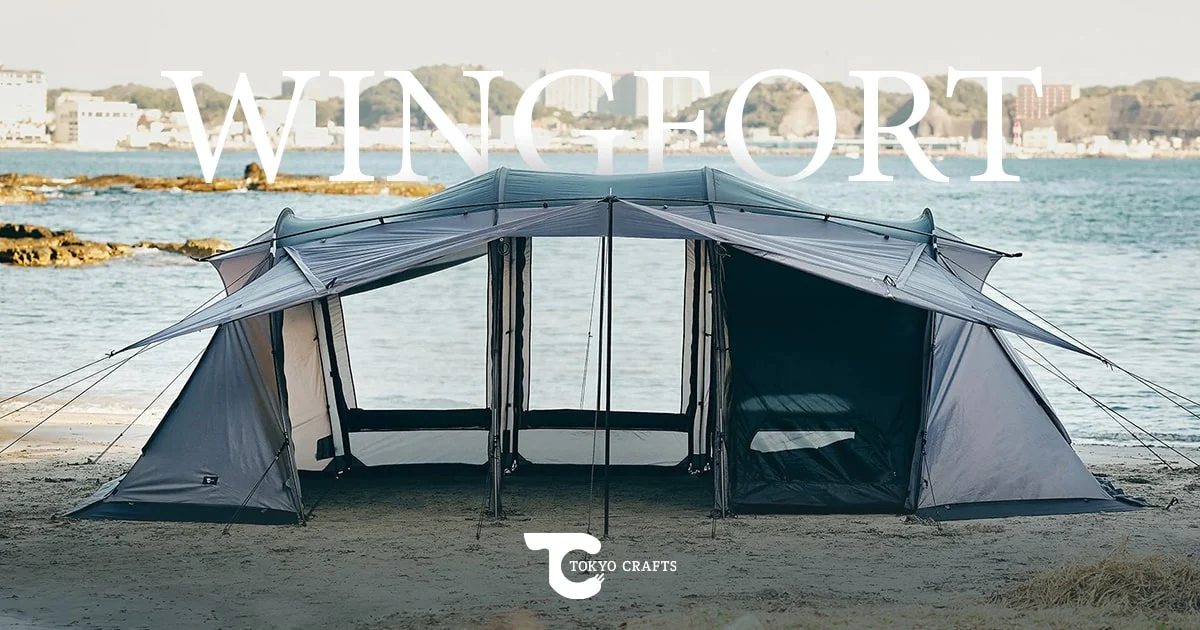
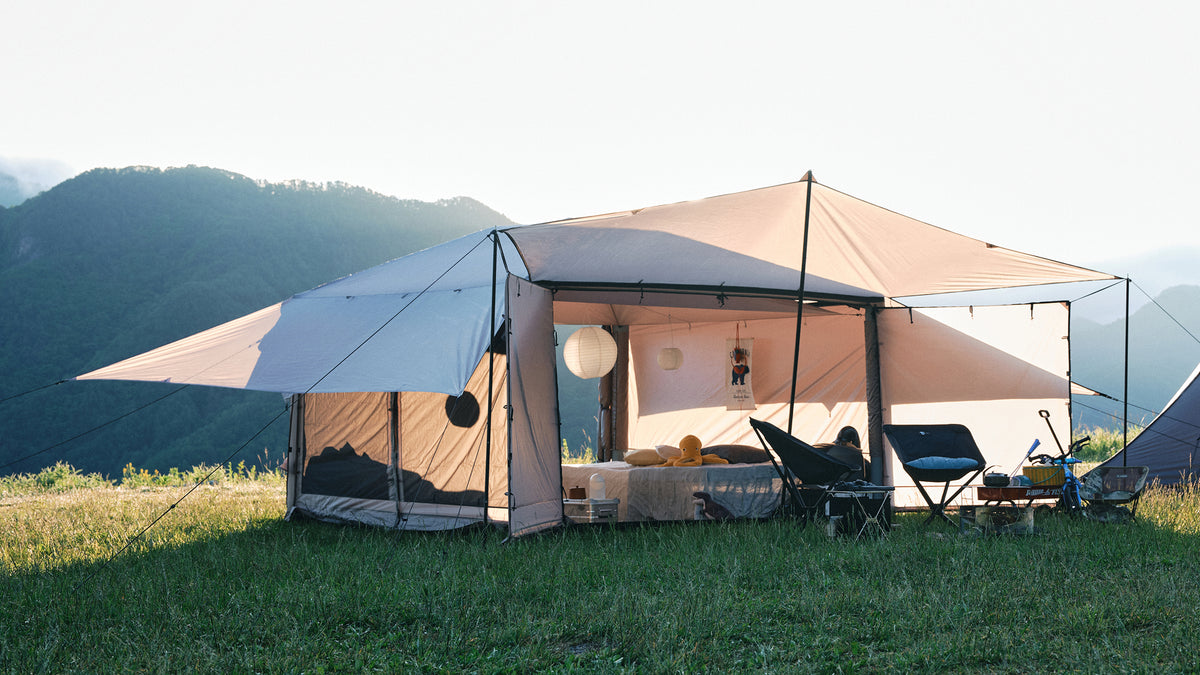
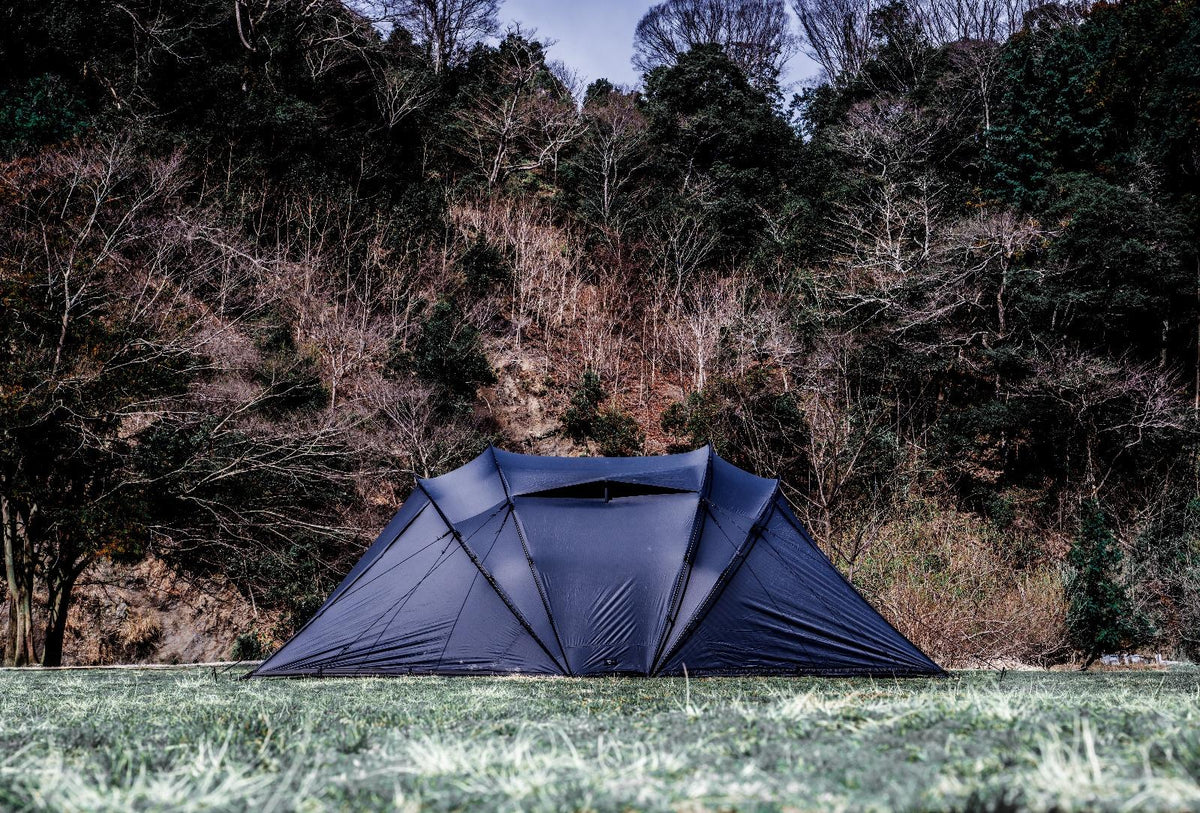
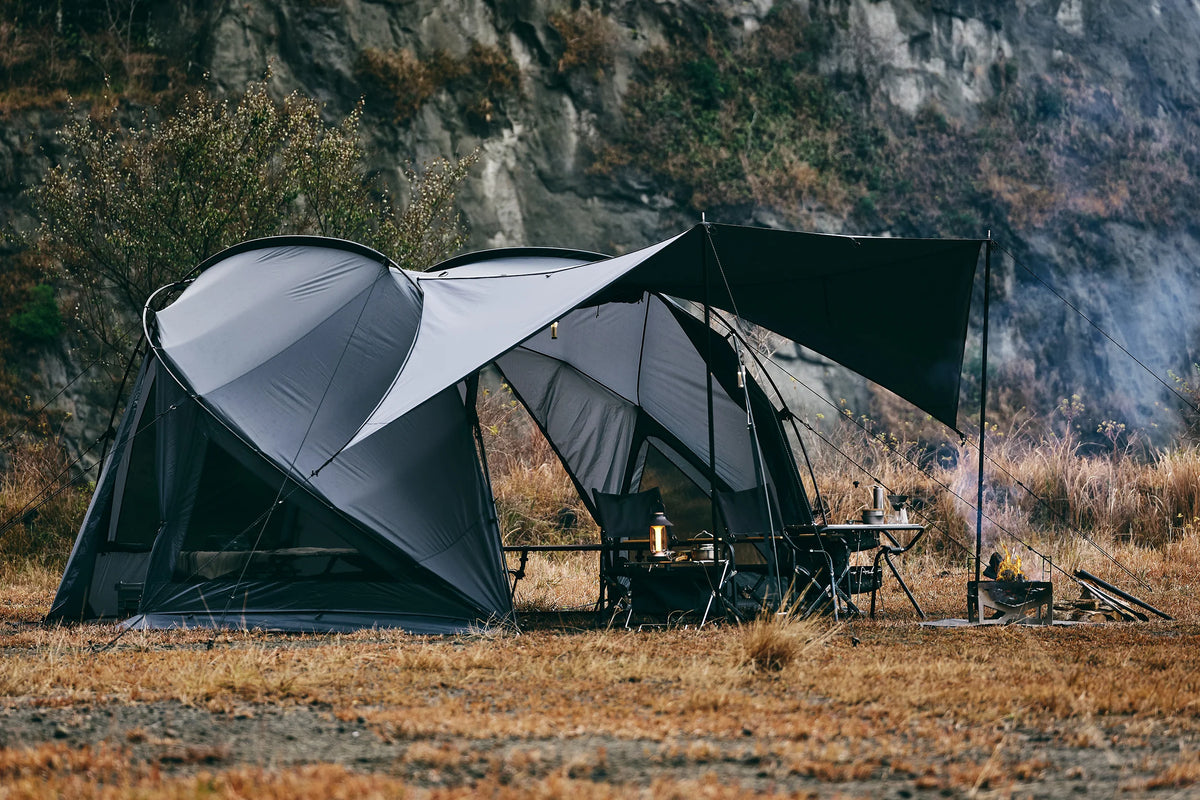
The "Wing Fort" is a double-layered tunnel tent featuring an outer panel. The outer panel provides solid protection against heavy rain and sunlight, creating a comfortable living space.
The outer panel can be raised using poles to function as a canopy. This allows you to secure a spacious living area even when camping with a large group.
The "inner tent," which serves as the sleeping area, is a welcome standard feature. It comfortably sleeps a family of four.
With a wide range of optional accessories available, you can tailor your setup to your camping style for an even more comfortable experience.
[Optional Items]
▶︎Click here for the Wingfort Complete Set
Effica

Featuring lightweight materials and an easy-to-set-up design, the "Effica" offers refined usability without relying on excessive features.
Despite its spacious interior, the main unit weighs only about 8.4 kg, minimizing the burden of transport and setup while ensuring a comfortable camping experience. Thanks to its 40D silnylon fabric and simple frame design, setup is smooth and easy, even for beginners.
Its symmetrical design allows for setup without worrying about orientation, and it features flaps on both sides that can be lifted for easy access. With ample headroom, you can freely arrange the layout as a living room or bedroom for families and groups.
You can enhance comfort by using optional accessories.
[Optional Accessories]
▶︎Click here for the Efika Complete Set
Grahus

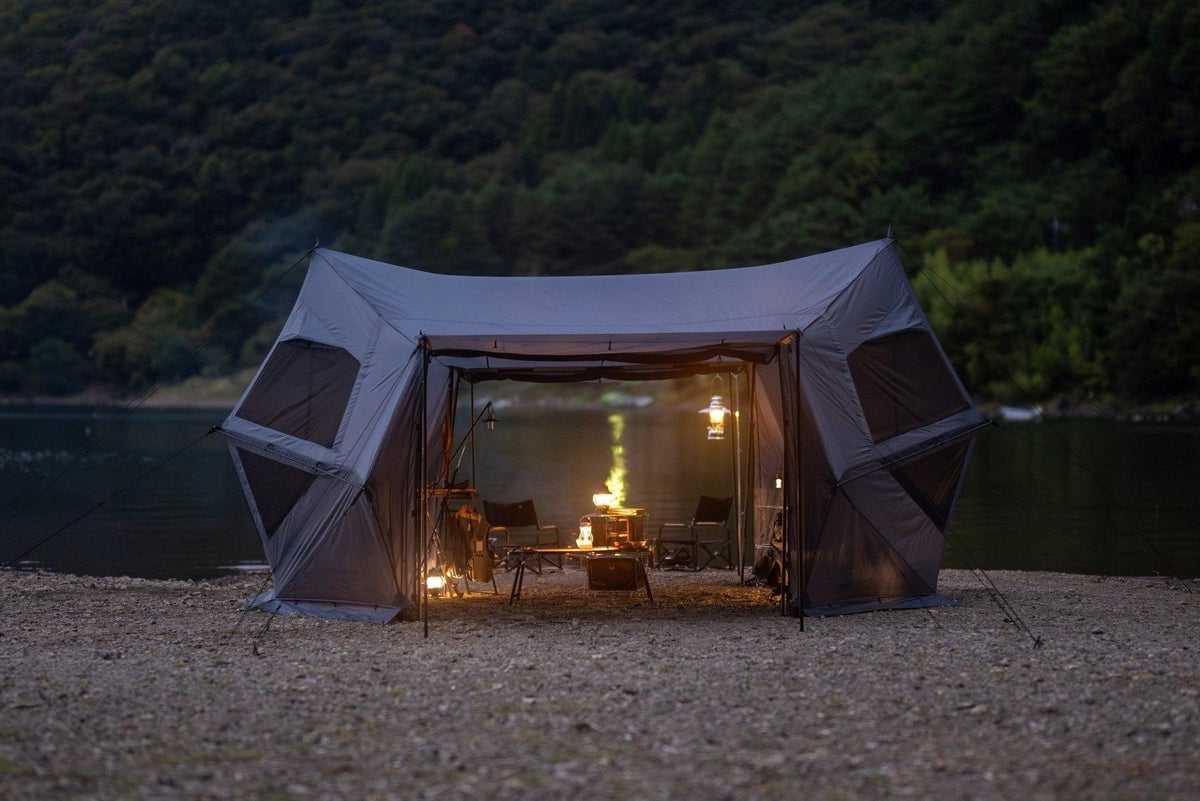
"Grahus" is a large shelter tent designed with the concept of a portable glamping experience. With its unique, building-like form and large windows, it creates a spacious interior filled with a sense of openness, making camping with family and friends even more comfortable.
Made from 75D polyester fabric with high water resistance, its size is designed to fit approximately 10m x 10m campsites, making setup a breeze.
An inner roof is included as standard equipment, allowing you to enjoy camping in a comfortable space regardless of the season. Combine it with optional items to enjoy an even more luxurious outdoor living experience.
[Optional Items]
▶︎Click here for the Grahas Full Set
Large tents are a must-have for family and group camping! Choose carefully
Large tents let families and groups enjoy lively camping together. Their spacious size offers a sense of openness and high livability.
By referring to the selection tips and considerations introduced here, you can choose a large tent that perfectly suits your camping style.
We hope you find your favorite large tent and create lots of fun camping memories—whether it’s a quiet family getaway or a lively group outing.
RANKING
ランキング一覧へ